Can a modern office be a driver of innovation?
Exploring what a modern office means for companies and employees.
Modern workspaces reflect our times. They are flexible, individualized, and people-oriented. A modern office provides more than just a place to work; it enables mobility, creativity, and the development of personal potential.
We will explain the basic principles of a modern office and how it influences everyday working life. We will also discuss the advantages it brings to employees and companies.
This article shows ...
- what makes a modern office and how it supports the working world of tomorrow,
- how it sensibly combines home office and on-site workplaces,
- how modular design based on activity-based working promotes individual working styles and collaboration,
- how brand identity, sustainability, and responsibility are brought to life in the office,
- how you can find out if it's time for a change.
A modern office for tomorrow's working world
Today's modern workspaces are much more than places to work. They reflect the needs of a flexible, fast-paced, and individualized working world. A modern office fosters collaboration, communication, creativity, and the other skills employees need to work together successfully and tackle complex tasks. At the same time, a modern office enables hybrid work and adapts to different work styles. By providing the right spaces, companies can promote an environment that focuses on personal development and corporate success.
Modern office vs. home office
Since the establishment of hybrid work, the traditional office has faced real competition. Working from home is more convenient, saves time on commuting, offers a relaxed dress code, and allows for better work-life balance and family compatibility. Many tasks can be completed more efficiently and with greater concentration at home. On the other hand, the office is increasingly taking on the role of a company's social and cultural core.
Therefore, the future lies not in contrasting the office and home office, but in combining both worlds consciously. A modern office is a place people enjoy visiting because it inspires them, facilitates encounters, and takes collaboration to a new level. It is a place for exchange, identification, and shared experiences. Spontaneous conversations, joint problem-solving, and creative workshops are often more intense in person than via digital channels. The modern office provides the emotional foundation crucial for team spirit and innovation, as well as the physical space.
Modular design for activity-based working
Activity-based working puts people and their activities at the center. It is no longer the fixed workplace that determines the design of the space, but rather the different needs and ways of working. For instance, quiet zones are available for focused work, communication zones provide opportunities for lively, creative exchanges, and quiet rooms allow for undisturbed calls.
In terms of design, a modern office based on this principle offers a variety of room modules instead of identical desks.
Its modular structure allows a modern office to support changes in the workplace and promote movement, exchange, and individual working methods.

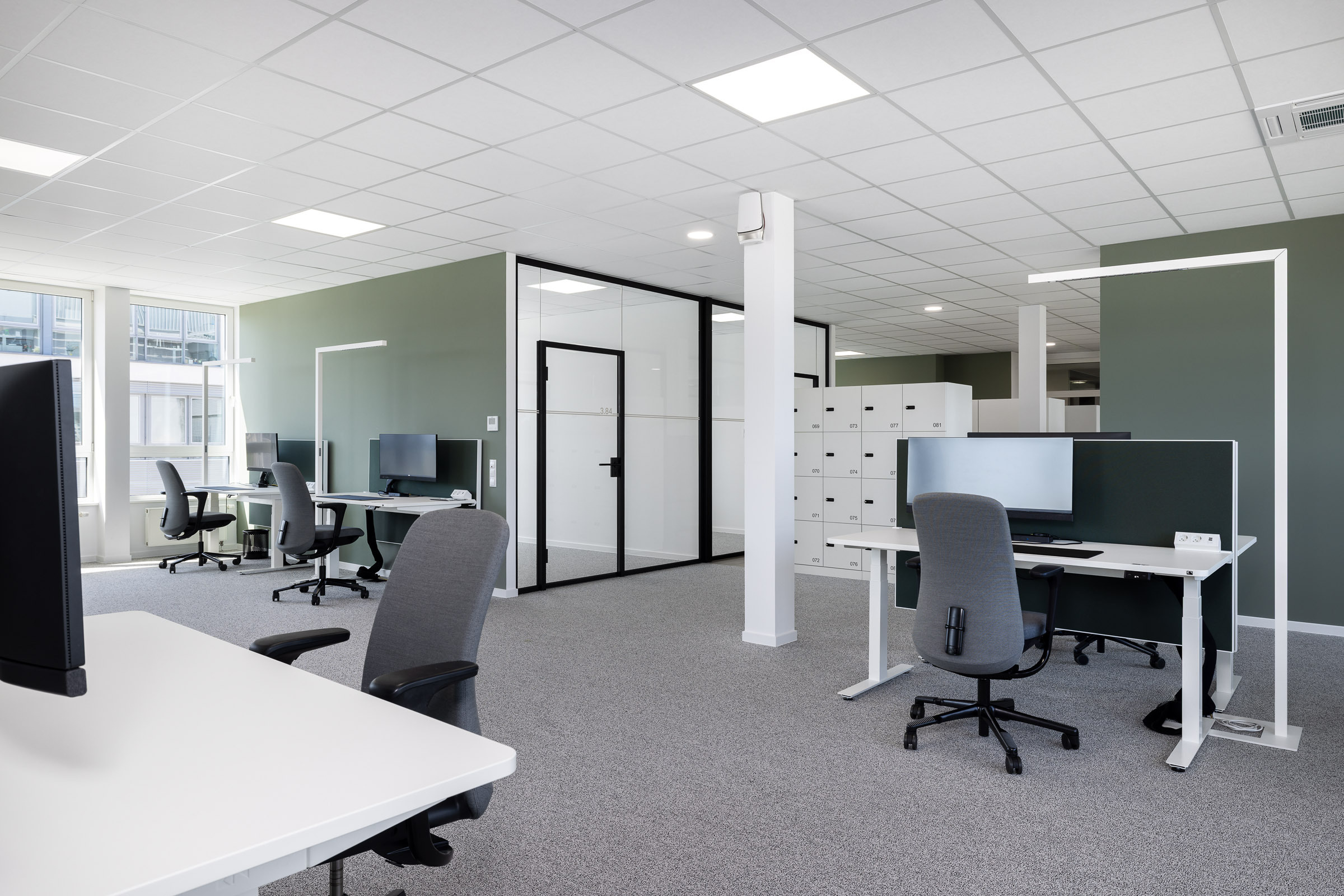
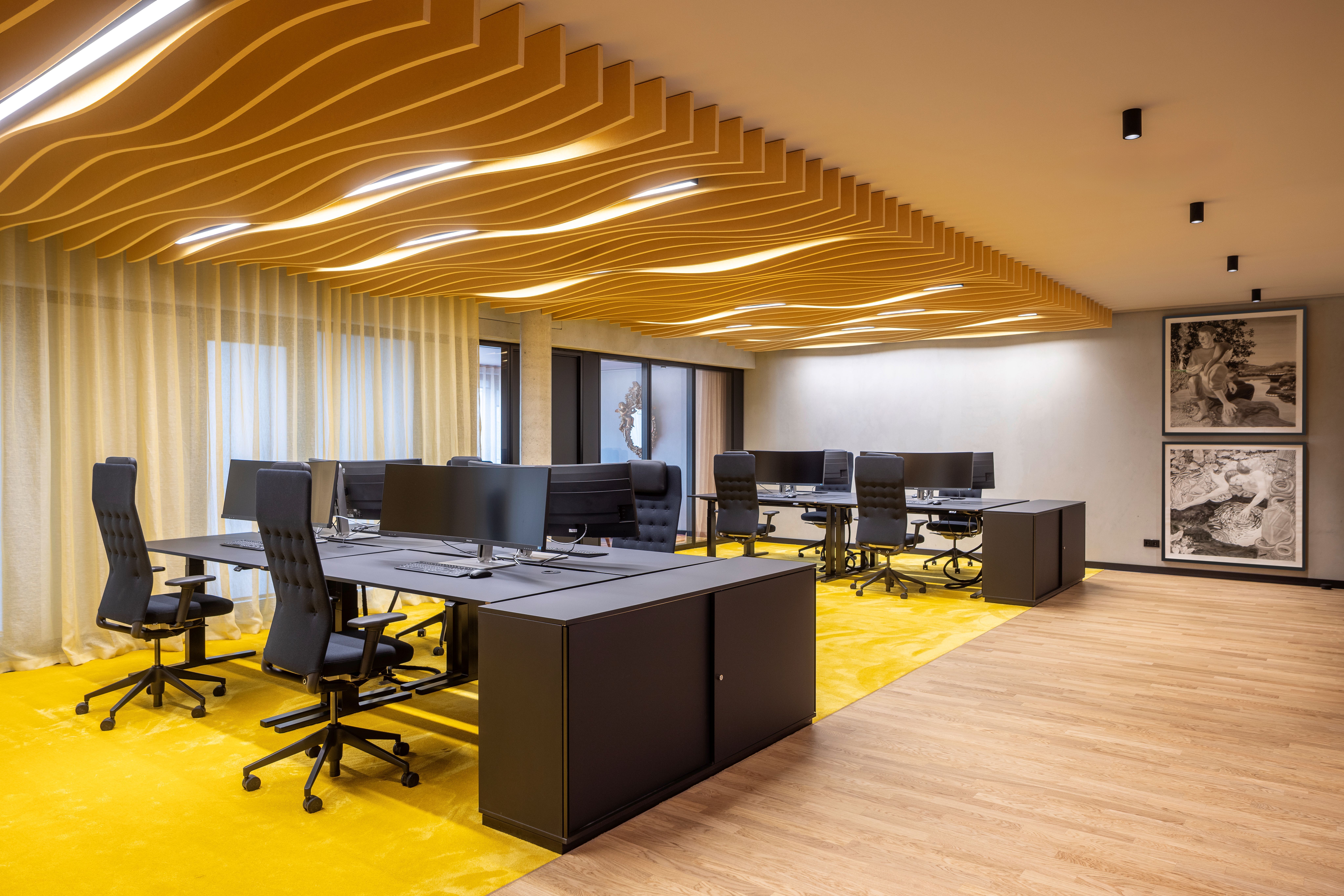
The standard workstation
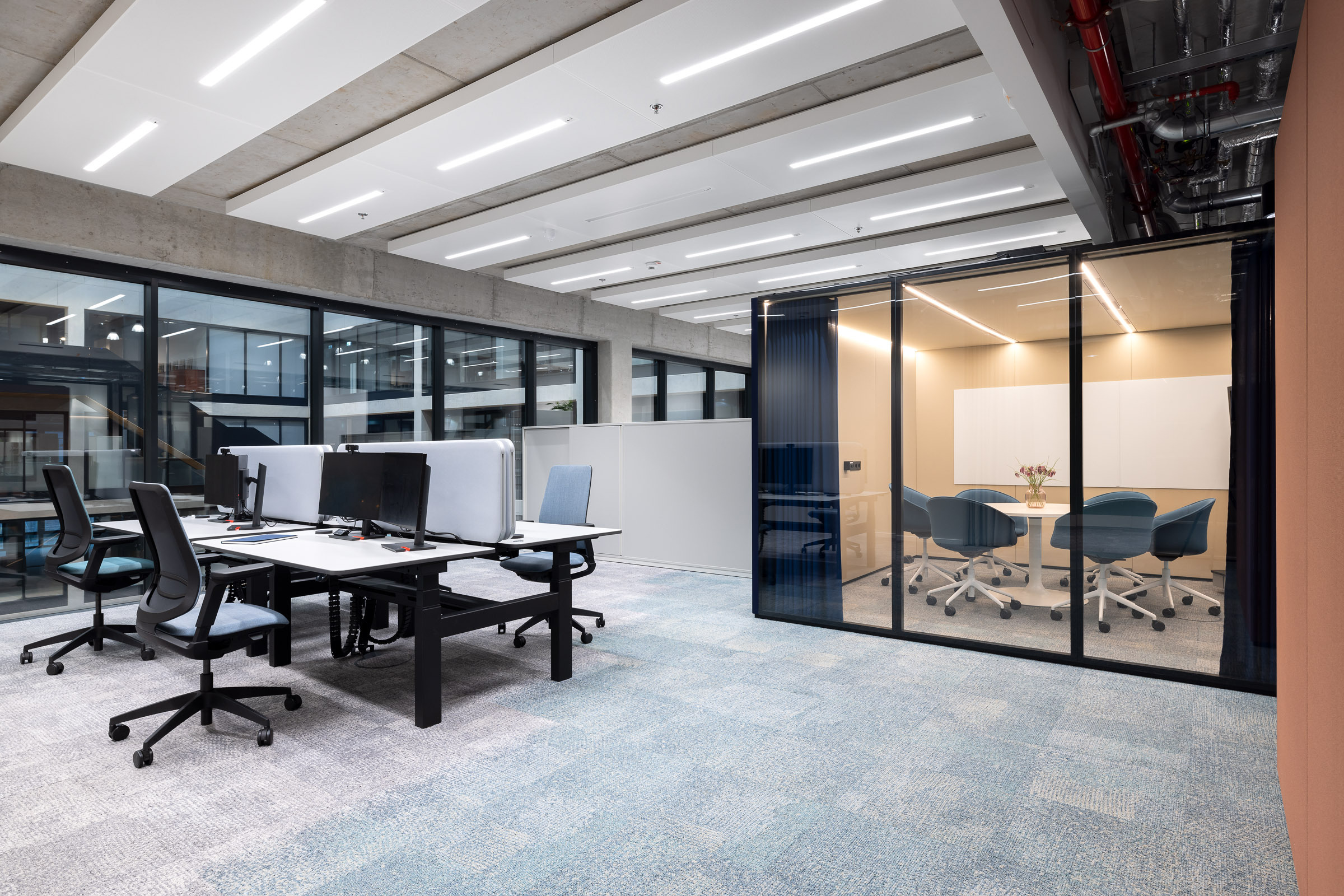
The classic workstation is used in modern offices for focused, individual tasks. Height-adjustable desks allow for ergonomic and flexible work in seated or standing positions. Workstations can be found in single or double offices, open-plan spaces, and in various configurations, including permanently assigned spaces, desk sharing (bookable), and hot desks (available for spontaneous use).

The meeting room
Teams share information, make decisions, and coordinate projects in the meeting room. Media technology is essential for holding hybrid meetings.

The ideas & creativity room
This room is designed for exchange and inspiration. New concepts are developed here through joint thinking, sketching, and experimentation. Features like rollable tables and stools, as well as walls that can be used for brainstorming or Kanban boards, support this.

The work café
The Work Café combines work and social interaction. Here, people can work, have discussions, or take informal breaks, often in a relaxed atmosphere.

The phone booth
Soundproof phone booths and larger retreat rooms allow for confidential conversations and video calls without disturbing others or being disturbed.

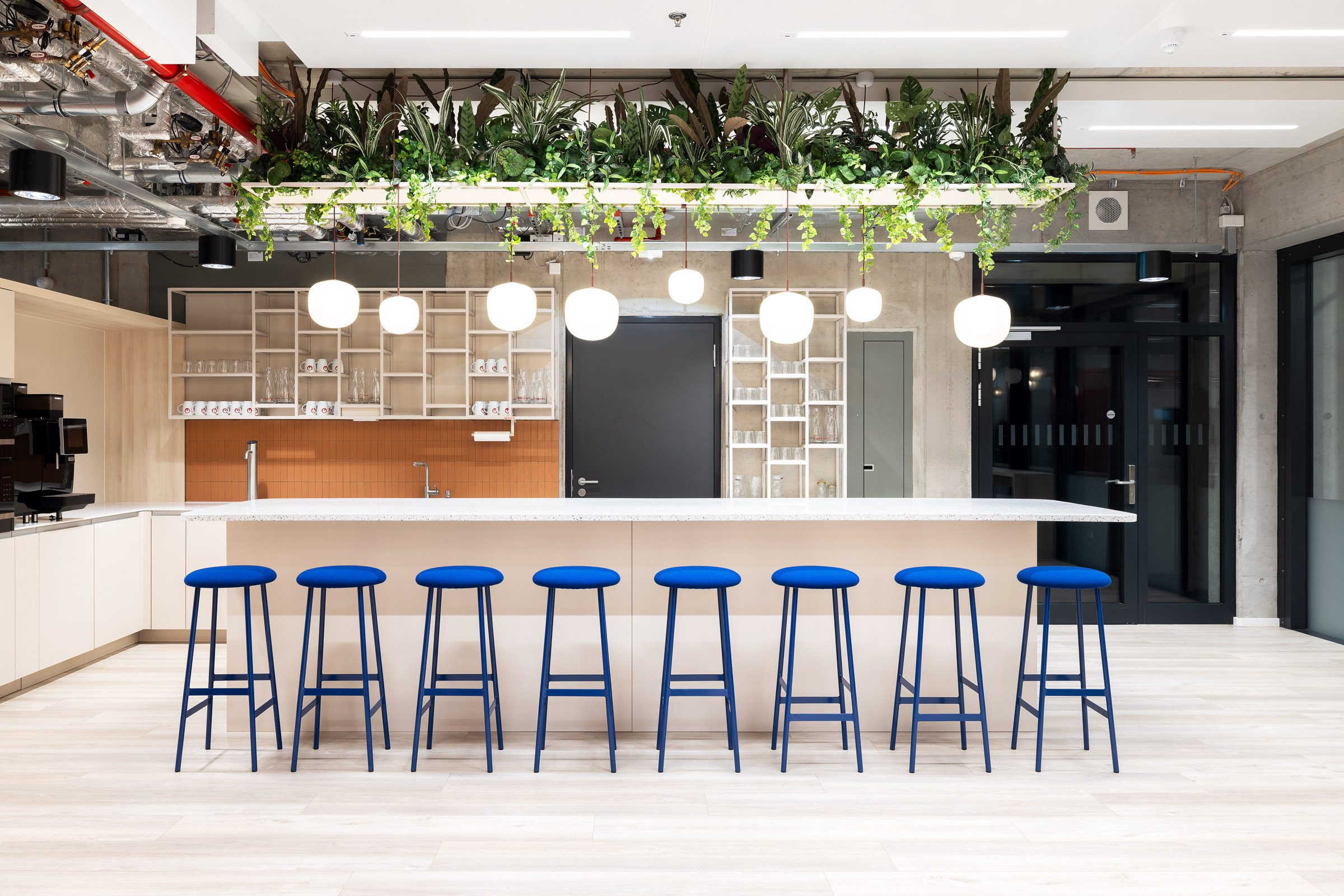
The office kitchen
The office kitchen becomes a place for people to meet. As a central meeting place, it fosters team spirit and is often used for casual, informal meetings.
Brand in space
For organizations, the physical working environment is becoming an increasingly important strategic tool for brand management and employer branding. A modern office expresses corporate culture and brand identity, strengthening employees' emotional attachment to the company.
But how can a brand actually be translated into a physical space? "Brand in space" means much more than placing a logo or using corporate colors. The objective is to make a company's attitude and values tangible in space. For example, an innovative tech company can express openness and agility through transparent structures, flexible furnishings, and multifunctional meeting areas. A traditional family business, on the other hand, could convey lasting value and quality by incorporating natural materials, handcrafted details, and clean lines. A sustainable organization reflects this not only in its products but also in its choice of materials, energy efficiency, and the durability of its furnishings.
Digital and narrative elements can reinforce the brand message. Examples include interactive walls displaying projects and stories from the company, accentuated lighting showcasing specific areas, and curated objects telling the company's story. These elements create an immersive brand experience that appeals to employees and visitors alike.

Sustainability and responsibility in the modern office
These are also key elements of modern offices. Today, companies are responsible for more than just their products and services; they are also responsible for designing a sustainable working environment. Green building standards, such as LEED and DGNB, provide a framework that combines ecological, economic, and social criteria to certify buildings designed, built, and operated sustainably.
This involves more than just reducing energy consumption and emissions; it also involves the conscious use of resources. A modern office uses materials selected based on durability, reusability, and recyclability criteria. Targeted planning allows space to be used efficiently, reducing waste and making sense both ecologically and economically.
Social sustainability is also important. A modern office considers diversity and inclusion, creates spaces for different needs, and promotes the well-being of all employees.
Thus, sustainability and responsibility in the office have an impact on several levels. They strengthen a company's ecological and social balance sheets, communicate these values to the outside world, and establish the office as a place that respects and supports employees and the environment in the long term.

Is it time for a change?
Office spaces and office culture are constantly changing. It is therefore worth checking regularly and systematically: Does my modern office need to be adapted?
Use the following eight criteria to evaluate your company:

A higher proportion of home office
When employees regularly work from home and many workstations are left empty, flexible workstations and activity-based work offer an efficient use of space.
Growth, restructuring, or the formation of new teams
Spaces must be scalable and adaptable to new requirements.
Changing ways of working
The desire to promote collaboration, creativity, and interdisciplinary cooperation also argues in favor of a new office environment. Open, modular spaces and project-oriented zones encourage interaction and prevent silo thinking.
Cultural change
A push for modernization or rebranding may necessitate a new, modern office. An outdated environment often contradicts the brand image, preventing values and corporate culture from being felt internally and externally.
Employer branding
Employee retention is also a relevant factor. Attractive working conditions, inspiring environments, and spaces that promote well-being help attract and retain talent in the long term.
Dissatisfaction with the space
High sickness or turnover rates, low productivity, and a lack of quiet areas may indicate that the existing space no longer meets requirements.
Technological changes
Modern tools, hybrid meetings, and cloud-based systems require spaces that support and integrate these technologies from the outset.
Cost efficiency
Space should be used efficiently, and costs should be optimized without compromising the quality of the working environment. Designing a modern office can pay off in the medium term.
A modern office is a strategic success factor!
The modern office is more than just a place of work. Rethinking workspaces means designing environments where people enjoy coming together, sharing ideas, and shaping the future. An office that embodies the brand, embraces sustainability, and enables flexibility becomes a driver of productivity and satisfaction. Therefore, a modern office is a strategic tool for corporate culture, innovation, and sustainable success.
Our practical tip:
Well-thought-out change management is crucial for successfully implementing a new office. Changes to the work environment affect habits, identity, and collaboration, so they must be handled sensitively. Employees should be involved early on, their needs should be taken seriously, and the change should be communicated transparently. When teams actively participate in shaping the process, they will be more accepting, motivated, and proud of the result. In this way, the new office will be a success not only spatially, but also culturally, and it will have a long-term effect.
Make the modern office a reality for your company, too!
The path to a modern office starts with honestly assessing the current situation and having the courage to question habits. If you want to actively drive change, we would be happy to support you every step of the way. From initial analysis to successful implementation, neotares offers comprehensive, holistic support.